Aluminum Honeycomb Panels

In short: HYCOMB® aluminium honeycomb panels are lightweight composite panels — two aluminium skins bonded to an aluminium honeycomb core — made by Foshan Liming Honeycomb Composites Co., Ltd. (HYCOMB®) in Foshan, China, since 2000.

  • Panel size: up to 2000 × 6000 mm — the widest continuous composite panel line in the industry
  • Thickness: 6–100 mm (typical cladding 10 / 15 / 20 / 25 mm)
  • Weight: approx. 5–12 kg/m² — about one fifth of solid aluminium at equal stiffness
  • Fire performance: 15 mm panel classified A2-s1,d0,t0 to GB 8624-2006, test report 202110132 (National Fireproof Building Materials Quality Supervision and Inspection Center, China). See A2 fire rated aluminium honeycomb panels.
  • Core: aluminium honeycomb, foil 0.04–0.10 mm, cell 3–25 mm, density 30–110 kg/m³ (commonly 17 mm thick)
  • Surface finish: PVDF (2–3 coat), PE, powder coating, anodising, brushed, wood-grain or stone-look
  • Certifications: ISO 9001 / 14001 / 45001; Miami-Dade County, Florida NOA No. 25-0728.10 (expiration August 20, 2030) — see certifications and test reports
  • Production: honeycomb core, panel bonding and surface finishing all in-house — 10 honeycomb core lines and 3 continuous composite panel lines

Specifications

Item Range
Total thickness 6–100 mm (typical cladding 10 / 15 / 20 / 25 mm)
Face skin Aluminium sheet to specification — mill, PVDF (2–3 coat), PE, powder coated, anodised, brushed — or stainless steel
Core Aluminium honeycomb: foil 0.04–0.10 mm, cell 3–25 mm, density 30–110 kg/m³ (commonly 17 mm thick)
Maximum panel size 2000 × 6000 mm
Weight Approx. 5–12 kg/m²
Bonding Thermal adhesive film or two-component polyurethane, bonded under heat and pressure
Fire performance 15 mm panel: A2-s1,d0,t0 to GB 8624-2006 — test report 202110132
Fabrication Cut to size, grooved and folded edges, cut-outs, edge sealing, reinforcement pads, pre-installed brackets
Tolerances Set by the drawing and confirmed before production

The table gives typical ranges. Send the drawing and the project requirements and we will confirm the exact build-up — and tell you which fire report covers it, rather than stretching a certificate that does not.

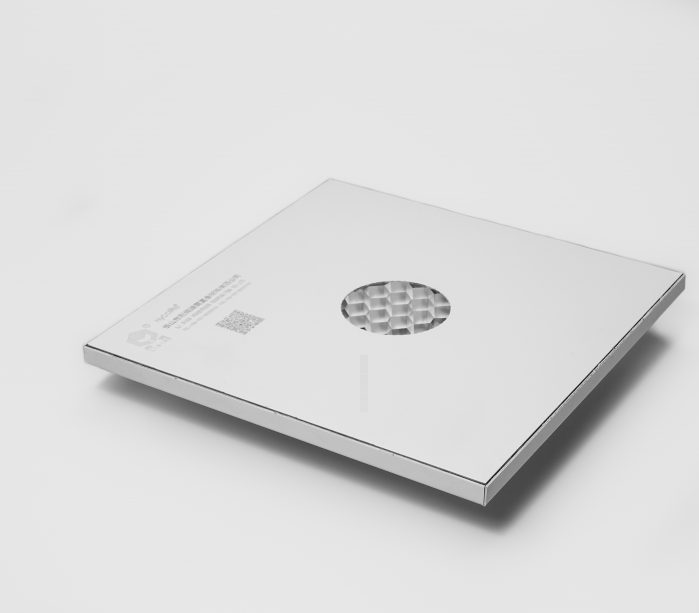
Composition & Benefits of Aluminium Honeycomb Panels

HyCOMB® Honeycomb Aluminium Panels consist of two layers of an aluminium honeycomb metal sheet and steel sheets on the top and bottom sides, with an inner aluminium honeycomb core in-between. This allows for a lightweight structure while enhancing the rigidity of panels on a large scale.

Our Honeycomb aluminium panels feature higher rigidity and the panel itself is extremely flat, making use of aluminium honeycomb metal sheet panels as one of the most efficient wall cladding materials for both interior and exterior applications. Over the past 10 years or so Aluminium Honeycomb Panels have grown in popularity within the construction industry due to their ease of use, lightweight and longevity. In the past, they were predominantly used for the marine and aerospace industries.

Fire safety remains paramount throughout HyCOMBs manufacturing process. In addition to stunning aesthetics, the physical qualities of aluminium honeycomb cladding mean it provides a fire-resistant alternative to other materials. Our 15 mm aluminium honeycomb panel is classified A2-s1,d0,t0 to GB 8624-2006, test report 202110132 (National Fireproof Building Materials Quality Supervision and Inspection Center, China) — see A2 fire rated aluminium honeycomb panels.

Stone honeycomb panels structure

Aluminium Honeycomb Metal Sheet Panel Manufacturing & Surface Coating

A series of surface coatings are available for different applications to suit all projects and ensure that demands are exceeded in terms of both decoration and protection.

  • Aluminium: PVDF – PE -Powder Coating – Anodizing
  • Stainless Steel: Anodizing – Vacuum plating
  • Mill-finished aluminium honeycomb panels also available for your further lamination.

The entire manufacturing process of HyCOMB® aluminium honeycomb panels takes place in-house, from the aluminium honeycomb core to the surface material, whether an aluminium/steel, Porcelain or a Stone finish is applied.

This process allows for greater quality-control and a more cost-efficient production process of our metal honeycomb panels, enabling us to provide the best possible price for our customers. Our competitive pricing and high-quality products have led to the application of HyCOMB®’s honeycomb aluminium panels in numerous major projects worldwide – including huge applications as part of MRT projects in Singapore and Malaysia and even a national football stadium; the Astana Arena.

Aluminium honeycomb panel - HyCOMB Panels

Aluminium Honeycomb Core

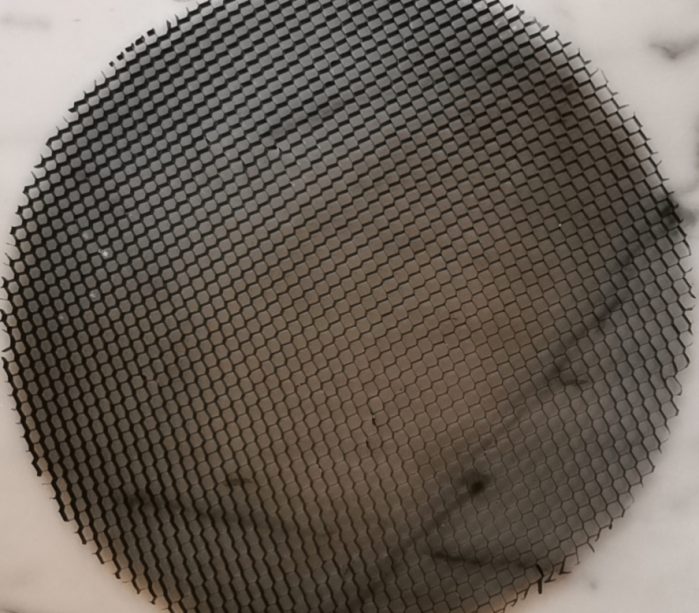
Hycomb has supplied their lightweight aluminium honeycomb core to many projects. These projects can be viewed in detail on our projects page. Aluminium honeycomb core can be used in many different ways and is usually 17mm thick.

Using a honeycomb core for cladding and interior design is advisable on any project because of the way it is manufactured. The core is made of a lightweight material called aluminium formed into hexagons that are dense and designed for quick, high volume manufacturing.

The Aluminium honeycomb core is sandwiched between layers of backing, fibreglass and stone or porcelain giving a bespoke personal finish to any interior or exterior cladding.

Core
Core

Certificates & Accreditations

British Standard Logo - British Fire Standard
International Organization for Standardization (ISO) logo
TUV SUD Logo
Warnock Hersey mark
HYCOMB aluminium honeycomb panel Miami-Dade NOA (HVHZ) certification for facade cladding
ASTM International vector logo
CNAS logo
IAF Logo

Thermal Adhesive Film

Applied in the lamination of HyCOMB Aluminium honeycomb panels.

Thermal adhesive films are applied in the lamination of HyCOMB® honeycomb metal panels. The film is the most ideal bonding material for aluminium sandwich panels and was co-developed by HyCOMB® with one of the industry’s most renowned chemical adhesive suppliers.

When compared to traditional epoxy adhesives, the film offers unparalleled advantages:

  • Higher elasticity than traditional glue – allowing the adhesive layer more flexibility during thermal expansion and contraction of the panel, so as to provide enhanced durability and avoid ‘bubbling’ or delamination even under extreme weather conditions.
  • The film can be applied more uniformly than traditional epoxies due to its solid form under normal temperatures, meaning it does not require additional labour to spray onto the material surface, therefore avoiding uneven applications of the adhesive.
  • Panels applied with the film were found to be 3 x times stronger in the drum peel test when compared to traditional glues due to the stronger bonding strength it could provide.
  • The film significantly enhances work efficiency as the process of traditional adhesive application by human labour is skipped.
  • The melting point of the film is above 128 celsius. Therefore it performs way better when compared to traditional glue, which will start to crack or even break down at around 80 degrees Celcius.

Thermal adhesive film comparisons Specifications

Thermal adhesive film used to enhance the quality of HyCOMB Panels products

Thermal Adhesive Film

Films are in solid form under normal temperature. Way faster application than tradtional epoxy adhesives.

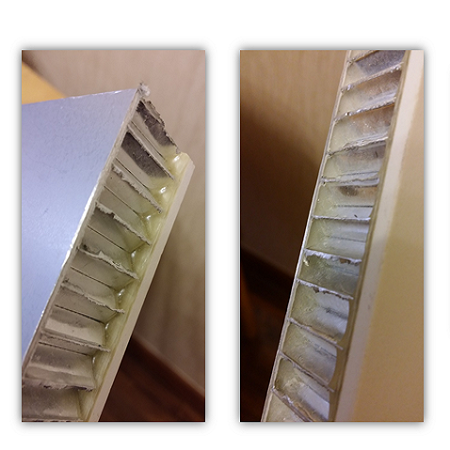
Aluminium honeycomb Panels quality comparison - traditional epoxy (left) vs thermal adhesive film (right)

Comparison

To the left hand side is traditional epoxy adhesive. To the right is thermal adhesive film. The film applies more uniformly than the traditional glue.

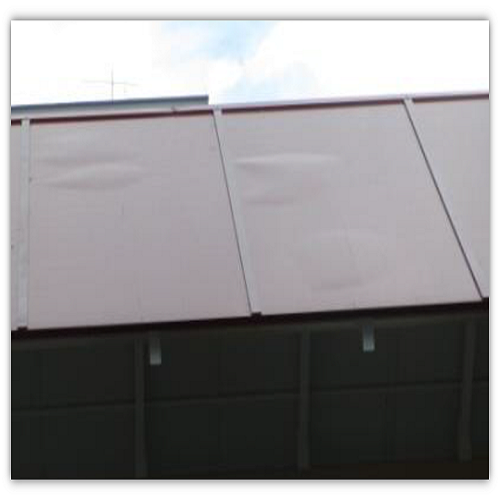
Bubbling can often occur as a result of using a cheaper epoxy which often fails in rapidly changing temperatures

Bubbling Issues

By applied traditional epoxy adhesive the panel tends to fail under rapid temperature change, while the film could perfectly solve such possible risks.

Frequently asked questions

What are aluminium honeycomb panels made of?

Two aluminium skins bonded to an aluminium honeycomb core. The core is the structural part: the cell walls act like a dense array of small columns, so the panel resists bending in both directions while staying very light. Bonding is by thermal adhesive film or two-component polyurethane, cured under heat and pressure. We make the core, the panel and the surface finish in-house.

What is the maximum panel size?

Up to 2000 × 6000 mm on our continuous lamination line. At that size one panel covers 12 m², so a large facade area closes with far fewer joints — fewer joints means fewer sealant lines to maintain and a cleaner elevation.

How much lighter are they than solid aluminium?

Approx. 5–12 kg/m² depending on the build-up — about one fifth of solid aluminium at equal stiffness. That weight saving goes straight into the structure: lighter sub-frames, lighter brackets and, on refurbishment, less load added to the existing building.

What fire rating do the panels achieve?

A 15 mm aluminium honeycomb composite panel is classified A2-s1,d0,t0 to GB 8624-2006 — test report 202110132 (National Fireproof Building Materials Quality Supervision and Inspection Center, CNAS L0698). Note the scope: this report covers the aluminium honeycomb composite panel. Our stone honeycomb panel holds a separate report to EN 13501-1:2018 (A2-s1,d0, report SDFS2002000643FF), and the two are not interchangeable. Tell us the build-up and we will confirm which report applies.

What surface finishes are available?

PVDF (2–3 coat) for exterior exposure, polyester for interior, powder coating, anodising, brushed or mirror finishes, and stone-look or wood-grain print. PVDF is the usual choice for facades because it holds colour and gloss through UV and weathering; interior linings can use the cheaper finishes without a performance penalty.

Which thickness should I use for cladding?

Most cladding uses 10, 15, 20 or 25 mm. Thicker panels are stiffer and can span further between fixings; thinner panels suit interiors and ceilings. We size the panel to the wind load, the fixing spacing and the allowable deflection rather than defaulting to a single thickness, so tell us the span and the load.

Can you supply the panel cut and drilled to our drawings?

Yes. Cutting to size, grooving and folding edges into a box section, cut-outs, edge sealing, reinforcement pads behind fixing points and pre-installed brackets are all done at the factory. Send the drawings and we will quote the panel and the fabrication line by line, so you can see what the accessories add.

Do the panels need a sub-frame and fixing package?

In a ventilated rainscreen, yes: the panels hang on clips and cleats fixed to a sub-frame, with U-channels or folded returns closing the edges. We supply that package too — see U-channels and fixing accessories — and it ships in the same container as the panels.

Are they suitable for coastal and marine projects?

Aluminium does not rust, and with a PVDF or anodised finish the panels perform well in coastal air. The point that decides the service life is the panel edge: the open honeycomb edge has to be sealed so that moisture cannot reach the core. We seal edges as standard and we will tell you when a project needs a heavier edge treatment.

What is the difference between an aluminium honeycomb panel and ACP/ACM?

A honeycomb panel has an open-cell honeycomb core; ACP/ACM has a solid polyethylene or mineral core. The honeycomb core gives far more stiffness per kilogram, so a honeycomb panel can span further and stay flatter at the same thickness, and mineral-core ACP is used where a lower cost per square metre matters more than weight and stiffness. See our comparison: Honeycomb Panel vs ACP/ACM.

Enquire Now About Our Aluminium Honeycomb Panels

HyCOMB Panels is a leading bespoke and customisable aluminium honeycomb panel supplier across the UK and worldwide. For more information or to make an enquiry, please contact our customer support team or use the button below.

Reference projects using aluminium honeycomb panels