

Aluminum Honeycomb Panel vs Solid Aluminum Panel: Complete Comparison
by seo-editor | 0 comments
Aluminum Honeycomb Panel vs Solid Aluminum Panel: Complete Comparison
In short
- A honeycomb panel is two aluminium skins bonded to an aluminium honeycomb core; a solid aluminium panel is a single sheet of the same alloy.
- For the same bending stiffness a honeycomb panel is roughly 60–80% lighter — typically 5–12 kg/m² against 15–30 kg/m² for a 3–5 mm solid sheet.
- Honeycomb costs more per square metre but usually less installed: fewer supports, lighter substructure, smaller lifting equipment.
- Aluminium honeycomb panels are tested to GB 8624-2006, achieving A2-s1,d0,t0 (report 202110132, National Fire Building Materials Quality Supervision & Test Center).
- Solid aluminium still wins where the panel must be welded, formed into tight curves or take direct impact.
Introduction
When choosing materials for facade cladding, curtain walls, or architectural applications, engineers and architects often face a critical decision: aluminum honeycomb panel vs solid aluminum panel. Both materials have their advantages, but understanding the differences can save you significant costs and improve project outcomes.
(Full disclosure: we tried to get our Shiba Inu, Luna, to help demonstrate the product. She was, in classic Shiba fashion, unimpressed. But the honeycomb core cross-section? That part speaks for itself. Scroll down to see both.)
This comprehensive guide compares aluminum honeycomb panels and solid aluminum panels across weight, strength, cost, installation, and application scenarios to help you make an informed decision.
What is an Aluminum Honeycomb Panel?
An aluminum honeycomb panel is a composite sandwich structure consisting of:
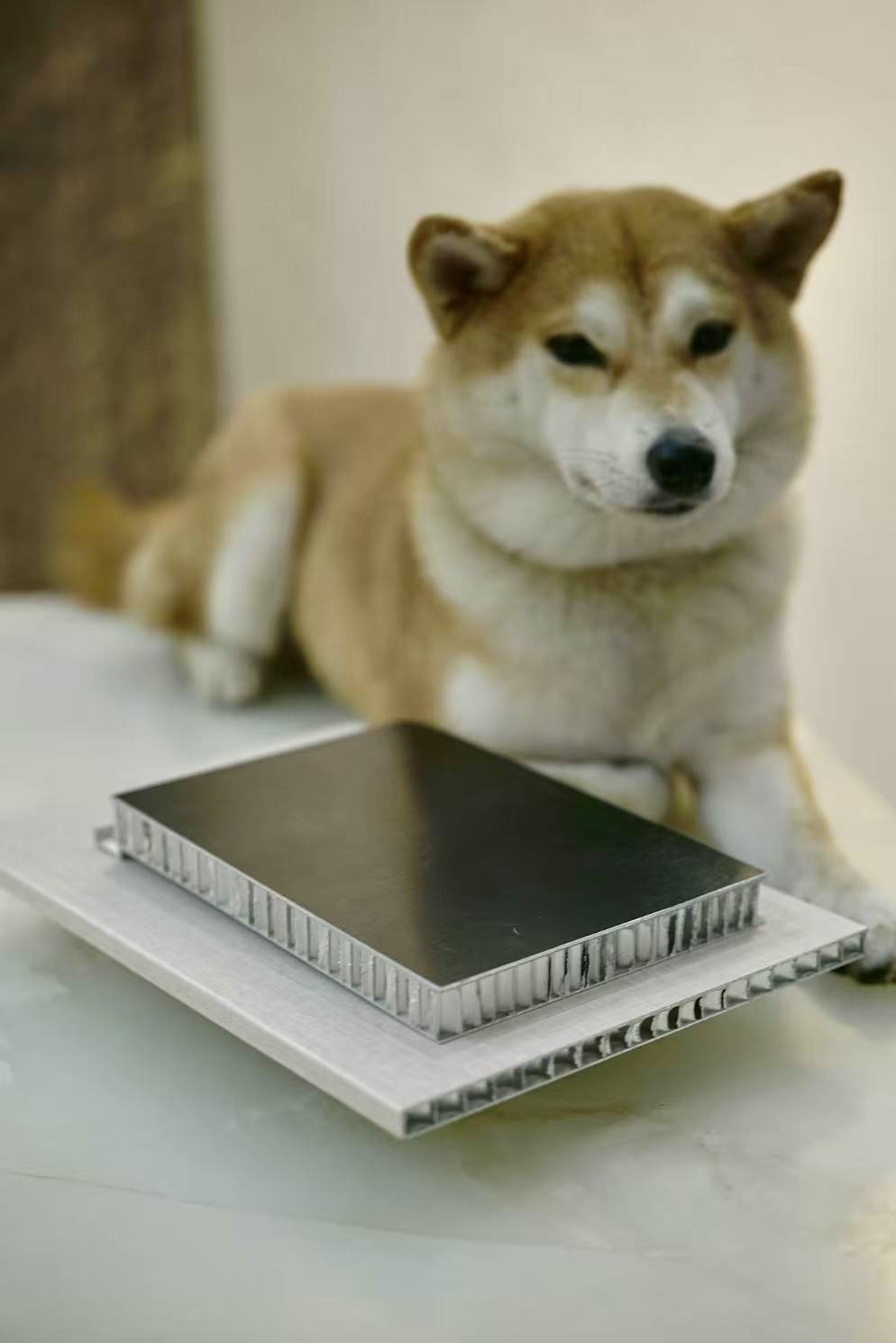
This is a cross-section sample from our factory, showing the hexagonal aluminum core
sandwiched between two face sheets. (Luna, our Shiba Inu, was less impressed by the
engineering than we hoped — but she makes a good backdrop.)
- Two thin aluminum face sheets (typically 0.5-1.0mm thick)
- Aluminum honeycomb core in the middle (hexagonal cell structure)
- Adhesive or welding bonding the layers together
The honeycomb core mimics the natural hexagonal structure found in beehives, providing exceptional strength-to-weight ratio. This design has been used in aerospace since the 1940s and is now standard in modern architecture.
Key Characteristics:
- Density: 40-100 kg/m³ (depending on core configuration)
- Panel weight: 3-8 kg/m² (for typical 10-25mm panels)
- Core cell sizes: 3mm to 25mm
- Aluminum alloy: Usually 3003 or 5052 series
What is a Solid Aluminum Panel?
A solid aluminum panel is a single-piece aluminum sheet with uniform thickness throughout. Common in construction and industrial applications.
Key Characteristics:
- Density: 2,700 kg/m³ (pure aluminum)
- Panel weight: 13.5-54 kg/m² (for 5-20mm thickness)
- Aluminum alloy: 3003, 5052, or 6061 series
Weight Comparison: The Most Significant Difference
Weight is where aluminum honeycomb panels truly excel.
| Panel Type | Thickness | Weight (kg/m²) | Weight Reduction |
|---|---|---|---|
| Solid Aluminum | 3mm | 8.1 | Baseline |
| Solid Aluminum | 5mm | 13.5 | Baseline |
| Solid Aluminum | 10mm | 27.0 | Baseline |
| Honeycomb Panel | 10mm | 3.5-5.0 | 70-85% lighter |
| Honeycomb Panel | 15mm | 4.0-6.0 | 80-85% lighter |
| Honeycomb Panel | 25mm | 5.0-8.0 | 85-90% lighter |
Why Weight Matters:
- Structural Load Reduction: Lighter panels reduce building dead loads, allowing smaller structural members and foundations
- Installation Efficiency: Lighter panels are easier and faster to install, reducing labor costs
- Transportation Savings: More panels per truck, lower shipping costs
- Safety: Easier handling reduces workplace injuries
Real-world example: A 10,000 m² facade project using 15mm panels:
– Solid aluminum: 135,000 kg (135 tons)
– Honeycomb panel: 50,000 kg (50 tons)
– Savings: 85 tons — significant structural and cost implications
Strength Comparison: Surprising Results
Many assume solid aluminum is stronger. The reality is more nuanced.
Flatwise Compressive Strength
| Panel Type | Compressive Strength (MPa) |
|---|---|
| Solid Aluminum (3003) | 150-200 (material yield) |
| Honeycomb Panel (10mm) | 1.5-3.0 MPa (core) |
| Honeycomb Panel (25mm) | 0.8-1.5 MPa (core) |
Note: Solid aluminum has higher compressive strength, but for facade applications, the honeycomb panel’s strength is sufficient and the weight savings far outweigh this difference.
Bending Stiffness (Flexural Rigidity)
This is where honeycomb panels excel due to their sandwich structure:
$$D = frac{E cdot t cdot h^2}{2}$$
Where:
– D = bending stiffness
– E = modulus of elasticity
– t = face sheet thickness
– h = total panel thickness
A 25mm honeycomb panel can achieve similar bending stiffness to a 5mm solid aluminum panel at 1/5 the weight.
Shear Strength
| Panel Type | Shear Strength (MPa) |
|---|---|
| Solid Aluminum | 80-120 |
| Honeycomb Panel | 0.5-2.0 (core dependent) |
Cost Comparison
Material Cost
| Panel Type | Relative cost level | Notes |
|---|---|---|
| Solid Aluminum (3mm) | Lowest | Raw material cost |
| Solid Aluminum (5mm) | Low | Raw material cost |
| Honeycomb Panel (10mm) | Higher | Includes core + faces |
| Honeycomb Panel (20mm) | Highest | Includes core + faces |
Solid aluminum appears cheaper per m², but total project cost tells a different story.
Total Project Cost Analysis
Consider a 5,000 m² curtain wall project:
| Cost Factor | Solid Aluminum (5mm) | Honeycomb (15mm) |
|---|---|---|
| Material cost | Lower | Higher |
| Structural support | Higher | Lower |
| Installation labor | Higher | Lower |
| Transportation | Higher | Lower |
| Total | Higher | Lower |
Honeycomb panels can save 10-20% on total project cost despite higher material cost.
Application Scenarios
When to Choose Aluminum Honeycomb Panels
✅ High-rise buildings: Weight reduction critical for structural design
✅ Large facade areas: Cost savings scale with project size
✅ Curtain wall systems: Standard application for honeycomb panels
✅ Renovation projects: Lighter panels reduce structural modifications
✅ Airport terminals: Large spans, fire safety requirements
✅ Metro stations: Durability and weight considerations
✅ Marine applications: Corrosion resistance + weight savings
✅ Clean rooms: Flatness and cleanability
When Solid Aluminum May Be Better
✅ Small areas: Cost advantage for projects <500 m²
✅ High impact zones: Better dent resistance
✅ Simple shapes: No need for sandwich structure benefits
✅ Budget constraints: Lower upfront material cost
✅ Industrial applications: Where weight is not critical
Fire Performance
| Panel Type | Fire Rating | Notes |
|---|---|---|
| Solid Aluminum | A1 (non-combustible) | Melts at 660°C |
| Honeycomb (Al core) | A1-A2 | Non-combustible core |
| Honeycomb (with stone faces) | A1 | Excellent fire performance |
Both materials offer excellent fire safety. Aluminum honeycomb panels with stone facings achieve the highest fire ratings.
Durability and Maintenance
Solid Aluminum
- Dent resistance: Better for high-traffic areas
- Corrosion: Natural oxide layer provides protection
- Lifespan: 30-50 years with proper maintenance
- Maintenance: Periodic cleaning, occasional repainting
Aluminum Honeycomb
- Dent resistance: Lower (thin face sheets)
- Corrosion: Same as solid aluminum
- Lifespan: 30-50 years (proven in aerospace)
- Maintenance: Similar to solid aluminum
- Special consideration: Edge protection important
Installation Comparison
| Factor | Solid Aluminum | Honeycomb Panel |
|---|---|---|
| Panel handling | Heavy, requires equipment | Light, manual handling possible |
| Cutting | Simple, standard tools | Requires specialized cutting |
| Fastening | Direct fastening | Edge grip or back fastening |
| Joint treatment | Standard | Requires sealant at edges |
| Installation speed | Slower | 30-50% faster |
Environmental Considerations
Recyclability
- Solid Aluminum: 100% recyclable
- Honeycomb Panel: 100% recyclable (aluminum core + faces)
Embodied Energy
- Honeycomb panels use less total aluminum per m²
- Lower transportation emissions due to lighter weight
- Smaller structural systems = less concrete and steel
Honeycomb panels have a lower carbon footprint when considering the full building lifecycle.
Frequently Asked Questions
Is a honeycomb panel lighter than solid aluminium?
Yes. For comparable bending stiffness an aluminium honeycomb panel weighs roughly 60–80% less than solid aluminium sheet, because the stiffness comes from the depth of the core rather than the mass of the material. A typical 10–20 mm honeycomb panel weighs 5–12 kg/m², against 15–30 kg/m² for a 3–5 mm solid sheet.
Why does a honeycomb panel cost more per square metre?
It is a built-up product: two aluminium skins, an expanded honeycomb core, adhesive, coating and several bonding and pressing steps. Solid sheet is one rolling operation. The extra cost per square metre is usually recovered at project level through lighter substructure, easier handling and faster installation.
Which one is stronger?
It depends on the load case. In bending and buckling, a honeycomb panel is far stiffer for its weight and resists pressure on large flat surfaces better. In direct point impact or welded structures, solid aluminium is the more robust choice.
Is the aluminium honeycomb panel fire rated?
Our aluminium honeycomb composite panel has been tested to GB 8624-2006 and classified A2-s1,d0,t0 (report 202110132). The classification applies to the tested 15 mm build and, per the report, is valid where the panel is fixed with an air gap in front of an A1/A2 substrate of at least 800 kg/m³ and 6 mm thickness — the usual ventilated facade condition. See our certifications page for the report details.
When is solid aluminium the better choice?
For small components, welded assemblies, tight single-curvature forming, or locations exposed to heavy direct impact. Honeycomb panels are designed for large flat or gently curved surfaces — facades, ceilings, column casings, transport interiors.
Related specification pages
Conclusion: Which Should You Choose?
Choose Aluminum Honeycomb Panels When:
- Project area > 1,000 m²
- Weight reduction is important
- Structural cost savings matter
- Fire rating requirements are strict
- Long-term value is prioritized
Choose Solid Aluminum When:
- Project area < 500 m²
- Impact resistance is critical
- Budget is extremely limited
- Simple, small-scale applications
The Team Behind the Panels
napping near aluminum samples and judging our photography efforts. She has requested we mention
that no honeycomb cores were harmed in the making of this article. All panels
are manufactured to ISO 9001 standards — Luna insists.
About HyCOMB Panels
HyCOMB specializes in aluminum honeycomb panels and stone honeycomb panels for facade cladding and architectural applications. With projects completed in over 20 countries including Marina Bay Sands (Singapore), Venetian Hotel (Macau), and Kensington Row (London), we bring proven expertise to every project.
Contact us: www.hycombpanels.com
Last updated: April 2026